
Playfair Makes Plans for 1,475 Meter Core Drilling Program at Country Harbour Property
The recent high gold price coupled with the lack of recent exploration has given Playfair a golden opportunity to produce a succession of high-quality exploration programs from its Golden Circle Project.
Playfair has recently completed 2,611 meters of core drilling at its Mount Uniacke property and is awaiting assay results. Mount Uniacke and Country Harbour are only two of eight properties in the Golden Circle Project. Playfair intends to investigate all eight properties and has selected County Harbour as the next area to be explored.
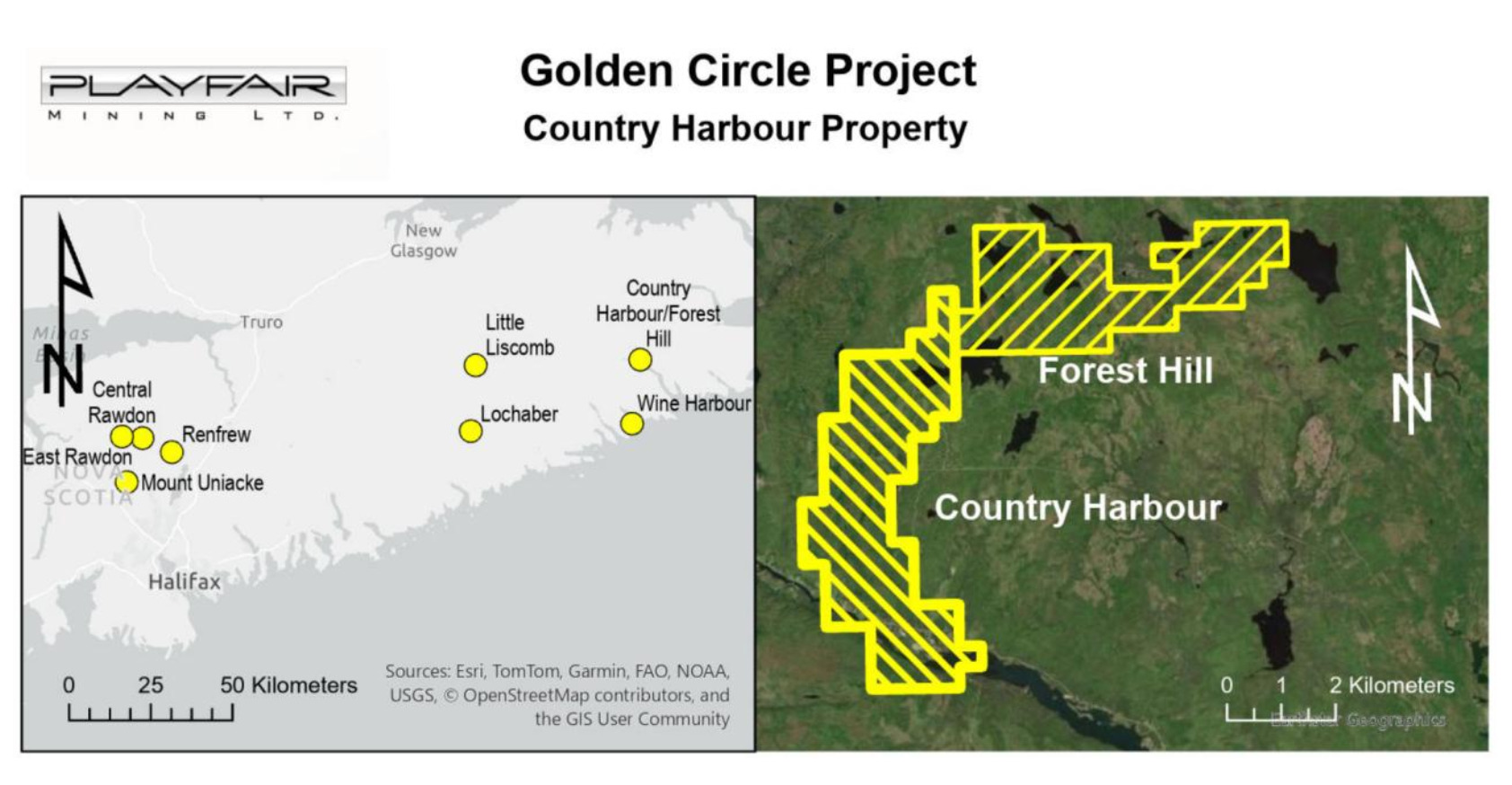
Playfair’s planned drill program at Country Harbour is guided by two significant facts revealed by a detailed compilation of previous work:
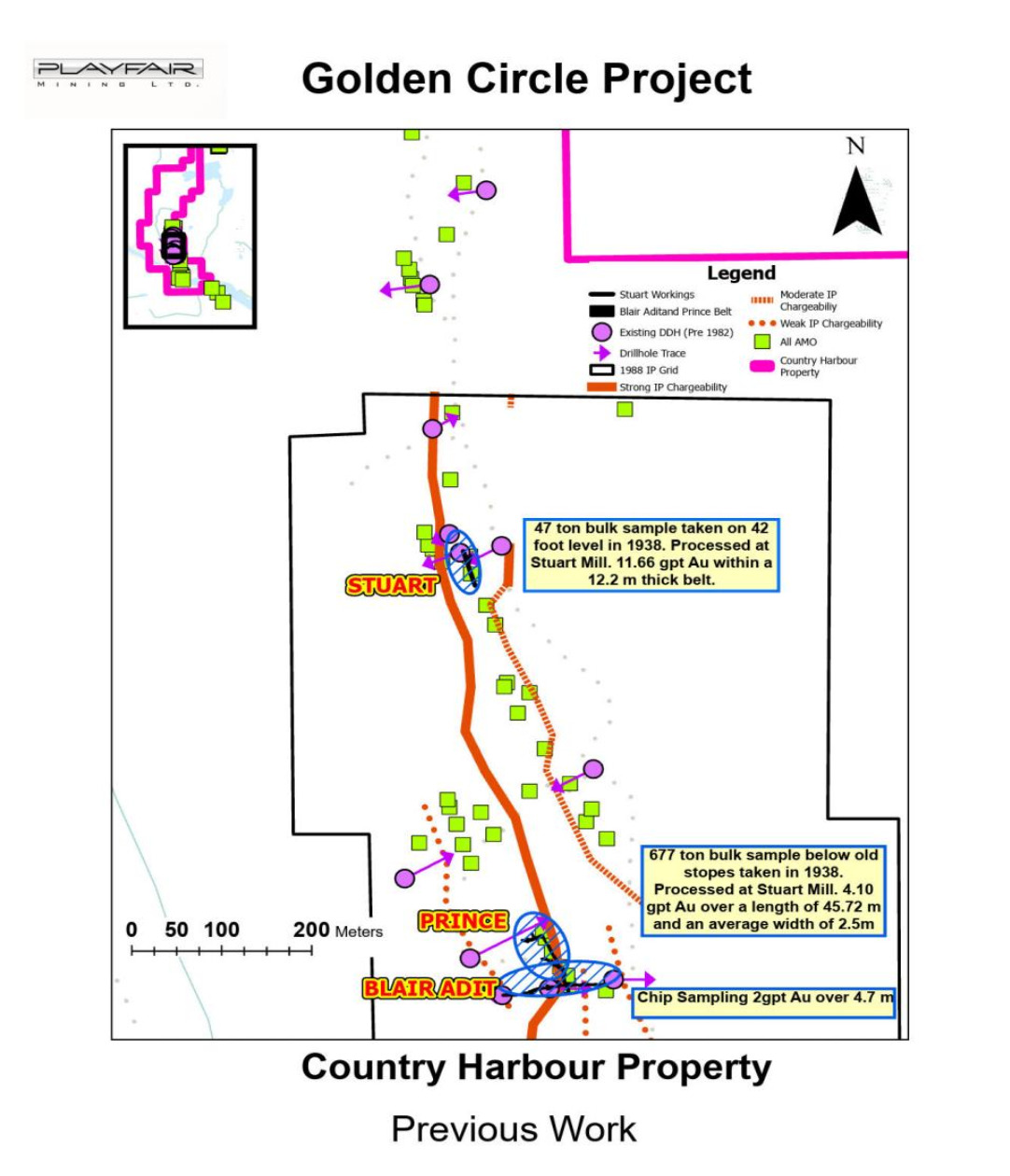
- Underground bulk sampling in 1938 revealed significant high-grade gold values at the lowest levels of the Prince and Stuart Mines. No deeper work is recorded.
- An Induced Polarisation geophysical survey in 1988 shows chargeability anomalies over the Prince and Stuart Mines. These anomalies continue for at least eight hundred meters and are essentially untested. Nearby, NexGold’s Goldboro deposit also shows a similar IP chargeability anomaly.
Based on these highly encouraging revelations Playfair has laid out a $600,000 exploration proposal. The main component of this proposal is a 17-hole core drilling program totalling 1,475 meters.
Playfair’s CEO Don Moore said “As the review of Country Harbour evolved, I became progressively more enthusiastic. Historical high-grade gold results from underground bulk samples at the Prince and Stuart mines coincide with high IP chargeability anomalies. It made for an easy decision to expand to Country Harbour next. We are looking forward to receiving completed test results from our first phase of drilling at Mount Uniacke while planning our next drill program at Country Harbour.”
Gold was discovered in the Country Harbour area in 1861 but there was little mining until the 1890’s when production was largely from the Prince, Stuart and Antigonish mines. All work had ceased by 1911. Work resumed from 1936 to 1941 when some old workings were dewatered, bulk sampled and a small amount mined.
Underground bulk sampling on the lowest level (75 feet or 23 metres) of the Prince workings in 1938 resulted in 837 tons which were processed in the Stuart Mill. Five Mill Samples were taken over a continuous drift length of 150 feet (45.72 m) with an average width of 8.2 feet (2.5m) and gave an average grade of 0.12 opt gold (4.1 gpt). A small amount of mining occurred in 1941. No deeper work is recorded.
At the Stuart Mine, levels were developed at 42 feet (12.8 metres) and 80 feet (24.4 metres). In 1938, a 47-ton Mill Sample taken on the 42-foot level was reported to grade 0.34 opt (11.66 gpt) gold within a 40 foot (12.2 metre) thick belt. A small amount of mining occurred in 1941. No deeper work is recorded.
Country Harbour, like many other Canadian gold mines, closed in 1941 primarily because the federal government reclassified gold mining as a “non-essential industry”. Labour, machinery and materials were redirected to “war-critical” base metal production. There is no record of any mining on the property in the 85 years since 1941.
Only 12 drillholes are recorded on the property, the last in 1981 targeting areas near old mine shafts. No further drilling is reported on the property in the 45 years since the 1981 drill program.
Seven years later in 1988 an Induced Polarization survey was carried out covering the area of known gold mineralization. The gradient IP showed a strong high chargeability anomaly for the full 800meter N-S extent of the survey. This anomaly is, in part, coincident with the Prince workings. A moderate 500-meter-long high chargeability anomaly is in part coincident with the Stuart workings. Most of the length of these IP anomalies have not been tested by drilling.
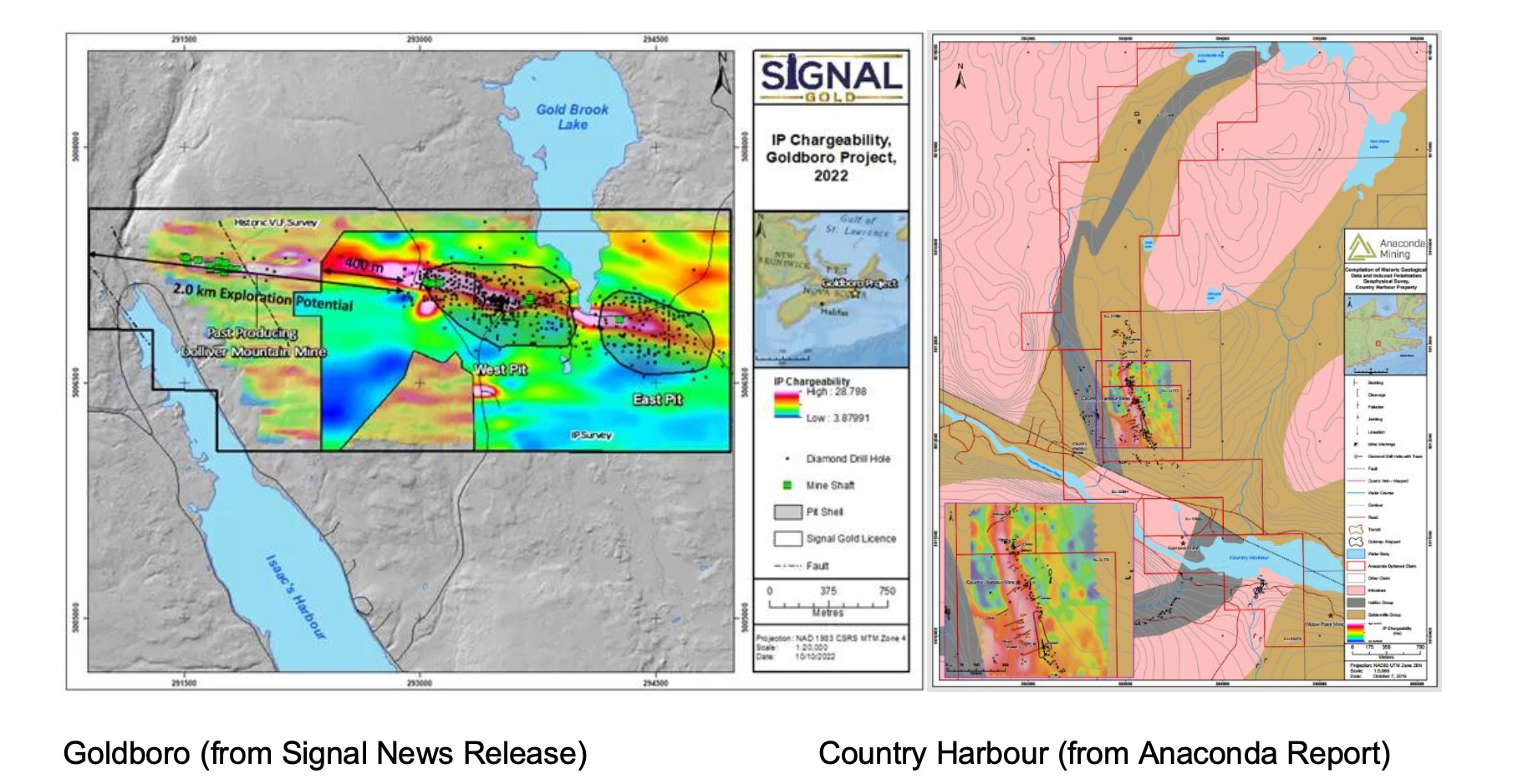
It is noteworthy that the nearby NexGold Goldboro deposit shows a strong IP high chargeability response which correlates with the known Goldboro mineral resource and its potential strike extensions (Signal Gold News Release October 13, 2022).
Playfair plans a minimum of 17 drillholes. Three will test the downplunge extension of mineralization previously sampled in underground workings, ten will test high chargeability IP anomalies and four will test gold occurrences found in outcrops or historical drilling.
A presentation on the Playfair’s Country Harbour plans can be found HERE.
To subscribe to Playfair’s Press Releases and periodic newsletters please Subscribe Here.
Neither the TSX Venture Exchange nor its Regulation Services Provider (as that term is defined in the policies of the TSX Venture Exchange) accepts responsibility for the adequacy or accuracy of this release.
The technical contents of this release were reviewed and approved by Greg Davison, PGeo, a qualified person as defined by National Instrument 43-101.
For further information visit our website at www.playfairmining.com or contact:
Donald G. Moore
CEO and Director
Phone: 604-377-9220
Email: dmoore@wascomgt.com
D. Neil Briggs
Director
Phone: 604-562-2578
Email nbriggs@wascomgt.com
Forward-Looking Statements: This Playfair Mining Ltd. News Release may contain certain “forward-looking” statements and information relating to Playfair which are based on the beliefs of Playfair management, as well as assumptions made by and information currently available to Playfair management. Such statements reflect the current risks, uncertainties and assumptions related to certain factors including, without limitations, exploration and development risks, expenditure and financing requirements, title matters, operating hazards, metal prices, political and economic factors, competitive factors, general economic conditions, relationships with vendors and strategic partners, governmental regulation and supervision, seasonality, technological change, industry practices, and one-time events. Should any one or more of these risks or uncertainties materialize or change, or should any underlying assumptions prove incorrect, actual results and forward-looking statements may vary materially from those described herein.